Technical Training Programs Strengthen Charlotte County’s Workforce Pipeline
June 15th, 2026
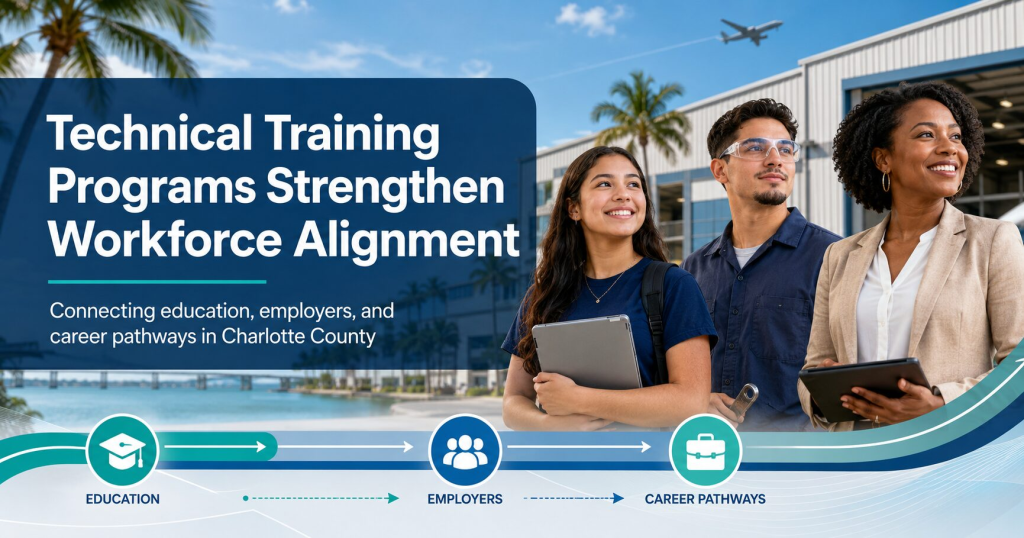
Technical training programs are receiving stronger national attention, and that matters for Charlotte County.
On May 13, 2026, the U.S. Departments of Education and Labor announced that 21 states submitted combined Workforce Innovation and Opportunity Act State Plans that include Perkins V, compared with 9 states in 2024. The announcement reflects a broader push to connect career and technical education with workforce development.
For Charlotte County, this is an important signal.
A strong local economy depends on people who are ready for the jobs employers need to fill. Students need clear career options. Workers need practical pathways to build skills. Employers need access to talent. Workforce partners need systems that work together instead of operating in separate lanes.
That is why the alignment between WIOA and Perkins V is worth watching.
WIOA supports the public workforce development system. Perkins V is the federal law that supports career and technical education programs, helping states connect classroom learning with the skills employers need. When these planning efforts are better connected, states can more clearly align training, credentials, workforce services, and employer needs.
In practical terms, this helps create a smoother path from classroom to career.
Why This Matters to Charlotte County Businesses
Workforce is one of the first questions businesses ask when they plan for growth.
- Can we hire the people we need?
- Can workers access the right training?
- Can local partners respond as industry needs change?
Those questions matter in Charlotte County because our economy depends on a mix of established employers, growing businesses, skilled trades, healthcare, aviation-related activity, logistics, construction, small business, and public-sector services. Each of these areas needs people with the right skills at the right time.
When education and workforce systems align, businesses benefit.
They gain a clearer path to talent. Training partners gain better insight into employer demand. Students and workers gain stronger guidance on which skills can lead to real opportunities.
That is the value of a more coordinated workforce system.
It does not replace local partnerships. It strengthens them.
Florida’s Role in the Combined State Plan
Florida is included in this national shift.
In the federal announcement, CareerSource Florida President and CEO Adrienne Johnston said Florida’s submission reflects coordinated work across core and partner programs and now includes Perkins V as part of the Combined State Plan. The announcement also included comments from Florida Commissioner of Education Anastasios Kamoutsas, who connected the integration of Perkins V to stronger alignment between education and workforce priorities.
For Charlotte County, that statewide coordination supports the kind of workforce development communities need to compete.
The goal is simple: make it easier for students, workers, employers, educators, and workforce partners to move in the same direction.
That matters because career pathways work best when they are visible, practical, and connected to real demand.
A Clearer Path From Training to Employment
A strong workforce system should not feel confusing.
People should be able to understand where to start, what training is available, what skills are in demand, and how education connects to employment. Employers should also have a clear way to engage with workforce and education partners.
This is especially important for students and adults who are considering career-focused training.
Not every successful career starts with the same path. Some workers enter the workforce through college. Others enter through technical education, apprenticeships, certifications, on-the-job training, or career changes later in life.
A more aligned system helps make those options easier to see.
That matters for residents. It also matters for employers that need dependable talent pipelines.
Why Partners Should Pay Attention
This announcement is also relevant for workforce, education, business, and community partners in Charlotte County.
A coordinated approach can help partners:
- Connect training programs with employer needs
- Support career awareness for students and families
- Help workers understand available career pathways
- Strengthen communication between education and industry
- Build a more responsive local workforce system
These are not abstract goals. They affect business growth, worker opportunity, and long-term community competitiveness.
When partners work from shared information and shared priorities, the entire system becomes easier to navigate.
What This Means for Economic Development
For Charlotte County Economic Development, workforce alignment is a key part of business retention, expansion, and recruitment.
Companies want to know whether a community can support their workforce needs. Existing businesses want confidence that they can grow here. New prospects want to see that education, workforce, and economic development partners understand talent development.
That is why stories like this matter.
They show that workforce development is not only about job openings. It is about building a system that connects people, training, employers, and opportunity.
Charlotte County’s role is to keep helping those connections become more visible and more useful for businesses, workers, and partners.
Conclusion
The U.S. Departments of Education and Labor announcement highlights a clear national move toward stronger coordination between career and technical education and workforce development.
For Charlotte County, the takeaway is straightforward.
When workforce systems and education partners are better aligned, businesses gain stronger talent support. Workers gain clearer pathways. Students gain better career options. Partners gain a more coordinated way to respond to employer needs.
That is good for economic development.
A community that prepares people for opportunity is also a community that prepares businesses for growth.
Sources
U.S. Department of Labor: https://www.dol.gov/newsroom/releases/eta/eta20260513
U.S. Department of Education, Perkins V: https://www.ed.gov/adult-programs/adult-education-laws-and-policy/perkins-v
Florida Department of Education, Perkins V: https://www.fldoe.org/academics/career-adult-edu/perkins/
CareerSource Florida: https://careersourceflorida.com/about-us/policies-and-initiatives/