Charlotte County Commercial Real Estate: Strong Growth
July 28th, 2026
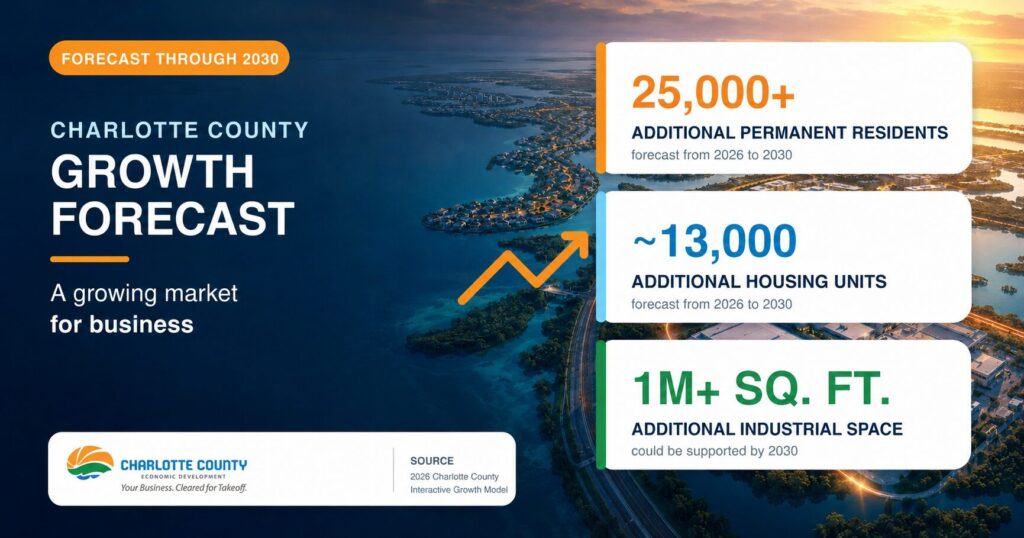
Charlotte County commercial real estate is central to the county’s latest growth forecast Charlotte County Interactive Growth Model presentation, July 28, 2026, to the Charlotte County Board of County Commissioners on July 28. The model reports that more than 50,000 permanent residents and 26,000 housing units have been added since 2020.
The model also forecasts more than 25,000 additional residents and approximately 13,000 additional housing units between 2026 and 2030. For companies considering relocation, investment or expansion, the findings provide current facts about market growth, emerging customer areas and future commercial and industrial needs.
The Charlotte County commercial real estate data does not predict the outcome of an individual project. Instead, it identifies market conditions that companies can examine through further research.
Charlotte County Interactive Growth Model presentation, July 28, 2026
Charlotte County commercial real estate
The 2026 Interactive Growth Model uses April 2026 property data and certificates of occupancy. In addition, it divides Charlotte County into 353 zones to examine where growth is occurring.
The presentation reports a 2026 permanent population of 237,982. It forecasts 263,451 residents by 2030, an increase of 25,469 people. Meanwhile, the housing forecast rises from 135,829 units in 2026 to 148,698 units in 2030. That represents 12,869 additional housing units.
For Charlotte County commercial real estate, this information connects population growth with location. As a result, a company can compare potential sites with future customer and workforce locations.
However, the model does not replace a market study, zoning review, traffic analysis or property inspection. It gives businesses an official Charlotte County commercial real estate forecast to use before completing site-level due diligence. The July 28 BOCC agenda identifies the Metro Forecasting Models update as a regular agenda item presented by Community Development.
Population growth expands the potential customer base
The presentation reports that Charlotte County has added more than 50,000 permanent residents since 2020. It also reports more than 26,000 additional housing units during that period. Moreover, since January 2025, the county has added 7,545 housing units.
For a company evaluating Charlotte County commercial real estate, these figures help define the size and pace of the expanding residential market. For example, more households can increase the need for groceries, dining, healthcare and other daily services. Still, actual demand will depend on each company’s customers, competition, pricing and location.
Meanwhile, the forecast extends that market view through 2030. Metro Forecasting Models projects more than 25,000 additional residents and approximately 13,000 new housing units. These are forecasts, not guaranteed outcomes. However, they provide a consistent planning period for reviewing Charlotte County commercial real estate needs.
Where population growth is forecast through 2030
The model divides Charlotte County into six planning clusters: Babcock Ranch, Burnt Store Road, East, Mid, Punta Gorda and West. Its spatial forecast shows that most residents added between 2026 and 2030 will be concentrated in several distinct areas.
Approximately 42% of new residents are forecast in Babcock Ranch. About 21% are forecast in the West Port area within the Mid cluster. The Rotonda area in the West cluster is forecast to receive approximately 14%. The Burnt Store Road corridor is forecast to receive 9%.
This distribution gives companies a more precise way to examine Charlotte County commercial real estate. Countywide totals show overall market size. In addition, the Charlotte County commercial real estate forecast shows where potential customer areas may expand.
Babcock Ranch has the largest projected share of new residents. Its population is forecast to increase from 14,996 in 2026 to 25,782 in 2030.
However, the fastest-growing area will not be the right location for every company. Existing population, competitors, property availability, road access, zoning and utilities also matter. Therefore, Charlotte County commercial real estate decisions require both broad market data and property-specific research.
Charlotte County commercial real estate supply
The presentation reports 14,877,740 square feet of commercial space in Charlotte County. With a modeled 2026 population of 237,982, that equals 63 square feet per resident. Therefore, the Charlotte County commercial real estate comparison is tied directly to population.
Metro Forecasting Models compared Charlotte County with Collier, Lee, Manatee, Sarasota, Seminole and Martin counties. The seven-county average shown in the presentation is 99 square feet per resident. Charlotte County has the lowest figure in that comparison.
This figure provides one measure of Charlotte County commercial real estate supply. However, it is not a vacancy rate and does not show the condition, price or immediate availability of individual buildings. Instead, it compares total commercial building space with the resident population.
The presentation states that commercial development continues to lag population growth. Therefore, expanding and relocating businesses have a reason to study where additional goods and services may be needed. Still, a company should review its industry, customers and competitors before selecting Charlotte County commercial real estate.
Charlotte County commercial real estate and shopping demand
The model also evaluates future shopping-center demand. By 2030, it indicates demand for three neighborhood shopping centers and three community shopping centers across Charlotte County. It does not indicate demand for a new regional shopping center by that year.
A neighborhood center generally provides frequently used goods and services near residential areas. By comparison, a community center serves a broader market and often includes more stores and services. The presentation connects both categories with future Charlotte County commercial real estate needs.
However, the forecast does not mean six shopping centers are approved or scheduled for construction. It is a model-based demand estimate. Therefore, any future project would still need a suitable site, private investment and all applicable reviews.
Still, the forecast helps retailers and developers compare households, competing centers, zoning, utilities and road access. Businesses can use the Charlotte County commercial real estate forecast to identify areas for further analysis. Next, they can complete their own market study, financial review and property due diligence.
Industrial space presents a separate growth measure
The presentation identifies a separate need for industrial development. Charlotte County has 7,063,818 square feet of industrial building space. Based on the modeled population, the county has approximately 30 square feet of industrial space per resident.
Meanwhile, the comparison group averages 57 square feet per resident.
As with the commercial comparison, this figure is not a vacancy rate or price comparison. It measures total industrial building supply relative to population. Still, it shows that the county’s industrial supply per resident is below the presented average.
Metro Forecasting Models forecasts industrial demand based on population growth. By 2030, the model says the county could support an additional 1,016,785 square feet of industrial building space and 147 acres of industrial development.
As a result, companies can review Charlotte County commercial real estate for manufacturing, warehousing, distribution and related operations. However, industrial projects within Charlotte County commercial real estate often need specific zoning, utility capacity, road access and building features.
The presentation also identifies Punta Gorda Airport as a resource that can encourage industrial employment centers. Punta Gorda Airport provides commercial service and general aviation access. In addition, Interstate 75 connects Charlotte County with the broader Southwest Florida region. Companies should evaluate each transportation asset according to their operating needs.
For existing employers, the forecast can support longer-term space planning. A company that expects to add production, storage or employees may need to identify Charlotte County commercial real estate options before its current facility becomes too small.
What Charlotte County commercial real estate data shows
The presentation does not select sites or predict whether an individual business will succeed. It documents the relationship between population growth, housing construction and nonresidential land needs. That information can help companies decide whether a closer market review is warranted.
| Presentation finding | Business relevance |
|---|---|
| More than 50,000 permanent residents added since 2020 | A larger resident base can expand the potential market for goods and services. |
| More than 25,000 additional residents forecast by 2030 | Companies can examine future demand over a defined planning period. |
| Growth concentrated in Babcock Ranch, West Port, Rotonda, Burnt Store Road | Businesses can compare potential sites with forecast customer locations. |
| 63 square feet of commercial space per resident versus a 99-square-foot average | The measure provides context for commercial supply relative to population. |
| Three neighborhood and three community shopping centers indicated by 2030 | Retailers and developers can identify areas that may warrant market analysis. |
| 30 square feet of industrial space per resident versus a 57-square-foot average | Industrial users can compare the county’s supply with the counties in the presentation. |
| About 1 million additional industrial square feet could be supported by 2030 | Companies and developers can review future industrial space and land needs. |
These findings support further investigation, not automatic conclusions. For example, a population forecast can show where a market may grow. However, it cannot answer every Charlotte County commercial real estate question. Businesses still need current listings, infrastructure information, labor data and financial analysis.
The Charlotte County Economic Development Office can help companies connect the forecast with local resources. Businesses can review available properties and contact the office for site-specific information. The office can also help companies identify the appropriate Charlotte County or City of Punta Gorda contacts for planning, zoning, permitting and infrastructure questions.
Using Charlotte County commercial real estate data
A location decision works best when broad market data and property-level facts are reviewed together. The growth model provides the broad view. It reports how many residents and housing units have been added, where growth is forecast and how the county’s commercial and industrial space compares with selected Florida counties.
The next step depends on the project. For example, a retailer may compare projected households with competitors. A manufacturer may begin with zoning, utilities, building size and access to Interstate 75. Charlotte County commercial real estate data can support each review, but the most useful measures will vary. Therefore, the presentation should serve as a starting point for due diligence.
The annual update also gives companies a current reference point. The 2026 model uses newer property data than prior versions. Therefore, Charlotte County commercial real estate decisions can use the latest model findings. For existing employers, the data can inform decisions about when to expand and where to look for future space.
Frequently asked questions about Charlotte County commercial real estate
What does the 2026 growth model forecast?
Metro Forecasting Models forecasts that Charlotte County’s permanent population will increase from 237,982 in 2026 to 263,451 in 2030. It forecasts that housing units will increase from 135,829 to 148,698.
How much has Charlotte County grown since 2020?
The presentation reports more than 50,000 additional permanent residents and more than 26,000 additional housing units since 2020.
Where is the largest share of population growth forecast?
Between 2026 and 2030, approximately 42% of new residents are forecast in Babcock Ranch. West Port is forecast to receive 21%, Rotonda 14% and Burnt Store Road 9%.
How much commercial space does Charlotte County have per resident?
The presentation reports 14,877,740 square feet of commercial space, or 63 square feet per resident. The seven-county average shown is 99 square feet per resident.
Will six shopping centers be built by 2030?
The model indicates demand for three neighborhood and three community shopping centers by 2030. It does not approve, schedule or guarantee their construction.
What does the model forecast for industrial development?
By 2030, the model says Charlotte County could support approximately 1 million additional square feet, or 147 acres, of industrial development.
Charlotte County commercial real estate: current data
The 2026 Charlotte County Interactive Growth Model documents continued population and housing growth. It also provides current comparisons for commercial and industrial building supply.
More than 25,000 additional residents and approximately 13,000 housing units are forecast by 2030. The model indicates demand for three neighborhood and three community shopping centers. It also says the county could support approximately 1 million additional square feet of industrial development.
For companies considering relocation or expansion, these findings provide a factual reason to examine Charlotte County commercial real estate in greater detail. The next step is to match the market data with a project’s requirements, including property availability, zoning, utilities, transportation access and workforce needs.
The Charlotte County Economic Development Office can help businesses review available sites and connect with the local information needed for a complete location analysis.
Sources
- Charlotte County Board of County Commissioners, July 28, 2026, Regular and Land Use Meeting agenda: https://charlottecountyfl.legistar.com/View.ashx?GUID=58703C19-714E-4258-A77D-BF68902678AB&ID=1403737&M=A
- Metro Forecasting Models, Interactive Growth Model services: https://metroforecasting.com/services/
- Charlotte County Interactive Growth Model presentation, July 28, 2026