Voices of Vision: Charlotte County Leaders Share Insights on Workforce Growth
October 21st, 2025


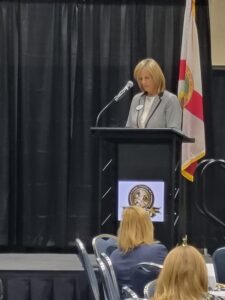
Bob White, President and CEO of the Charlotte County Chamber of Commerce
Bob White, President and CEO of the Charlotte County Chamber of Commerce, opened the evening with gratitude for the many hands behind the effort. “It takes a village,” he said, before thanking local officials, school board members, and chamber directors for championing workforce progress. “We’re thrilled to host this conversation for the greater good of Charlotte County – to talk honestly about the challenges we face and the opportunities we have.”
After the introductions, Kay Tracy, Director of the Charlotte County EDO, stepped forward to moderate the panel. She set the tone with the numbers: “Over the past two years, Charlotte County has grown more than eleven percent, adding nearly 11,000 new housing units and welcoming thousands of new residents and businesses,” she said. “With this growth comes opportunity and responsibility. We have to make sure our workforce, education systems, and industries evolve together.”
Tracy’s words framed the evening’s conversation among an accomplished panel: Dr. Eileen DeLuca, Vice President for Strategic Initiatives and Chief of Staff at FGCU; Michael Ehrat, CEO of HCA Florida Fawcett Hospital; Mark Vianello, Superintendent of Charlotte County Public Schools; and Dr. Chris Westley, Dean of FGCU’s Lutgert College of Business. Each brought a sector-specific view of how Charlotte County can grow smarter.
Higher Education: Partnerships that Build the Pipeline
Kay Tracy opened the discussion by noting the scale of recent growth. “Over the past two years, Charlotte County has grown more than eleven percent, adding nearly 11,000 new housing units and welcoming thousands of new residents and businesses,” she said. “With this growth comes opportunity and responsibility. We have to make sure our workforce, education systems, and industries evolve together.”
In response, Dr. Eileen DeLuca, Vice President for Strategic Initiatives and Chief of Staff at Florida Gulf Coast University, described how FGCU’s programs are evolving to meet those needs. DeLuca highlighted several ways for local employers to connect directly with the university. Businesses can register with FGCU’s Eagle Career Network, attend career fairs, and participate in the university’s unique Service Learning Program, which requires every graduate to complete 80 hours of career-related community service.
“Service learning isn’t just volunteering,” DeLuca said. “It’s a way for students to connect their studies to a future career while giving back to the community. We want those experiences to happen right here in Charlotte County.”
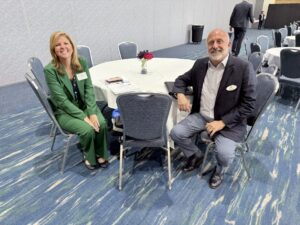 She also encouraged employers to align their goals with FGCU’s five-year strategic plan. “Partnerships start with mutual goals,” she explained. “If you see something in our plan that fits your business, reach out. We’ll build together.”
Healthcare: Technology and Human Connection
When asked about healthcare workforce challenges, Michael Ehrat described a landscape both demanding and full of promise. “The challenge isn’t just finding nurses,” he said. “It’s finding skilled professionals across every discipline – radiology, lab sciences, ultrasound, physical therapy. Those are high-skill, high-demand roles.”
To bridge that gap, HCA Florida Fawcett Hospital serves as a clinical training site for universities and technical colleges. “A large percentage of healthcare workers stay where they train,” Ehrat said. “That’s why we want local students in local programs.”
Ehrat explained that HCA provides tuition reimbursement and career-ladder programs so entry-level employees can advance without leaving the region. “We start talking about the next step on day one,” he said. “Retention is about more than pay- it’s about showing people a path.”
He also spoke about technology’s growing role. “As the county’s only comprehensive stroke center, we leverage telemedicine within minutes of a stroke patient arriving in our ER to connect with neurologists and begin diagnosis,” he said. “And as AI becomes part of healthcare, our partnerships with AWS and Microsoft focus on using it ethically – to reduce repetitive work so clinicians can spend more time with patients.”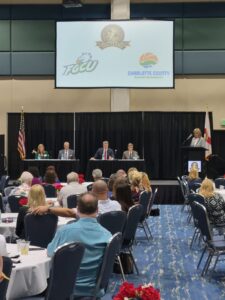
K-12 Education: Talent as a Universal Currency
For Superintendent Mark Vianello, talent is the currency of the future. “There’s a universal currency, and that currency is talent,” he said. “Developing talent within a region is a community problem – and community problems require community solutions.”
Charlotte County Public Schools’ approach blends career exploration, technical education, and direct employer partnerships. Programs in aviation, advanced manufacturing, cybersecurity, and healthcare were built by asking local industries what they needed. “We don’t design programs because a teacher wants to teach them,” he said. “We design them because employers tell us they’re needed.”
He invited business leaders to get involved through upcoming events: the Middle School Exploration Fair on January 20 and the High School Career Fair on April 20, where every eighth-grader and senior will meet local employers. “You can’t be what you can’t see,” Vianello reminded the crowd. “These events help students see that real careers exist right here.”
The district’s efforts are paying off. “Last year, we had the highest academic scores since 2013,” he said. “Our number of A schools rose by eighty percent, and our C schools dropped. We’re firing on all cylinders.”
Economic Outlook: Opportunity Through Differentiation
Turning to the broader economy, Dr. Chris Westley provided context for where Charlotte County fits in Florida’s growth map. “Do whatever you can to differentiate Charlotte County from Lee, Sarasota, and DeSoto,” he advised. “Regulatory climate and taxes matter – they attract investment and talent.”
Westley compared Charlotte County’s trajectory to Naples in the 1970s, a community on the cusp of transformation. “Back then, people assumed they’d leave Southwest Florida to build their careers elsewhere,” he said. “Now, you can have a full, productive career right here. That’s the difference local training makes.”
He also emphasized quality of life and culture as economic drivers. “What makes Charlotte unique? Maybe it’s the waterfront, the parks, or the arts scene. Develop those amenities,” he urged. “They’re what attract people long-term.”
Westley encouraged investment in what economists call ‘third spaces’ – coffee shops, libraries, coworking spaces, even cigar bars – where collaboration happens organically. “These are places where people share ideas and create knowledge spillover,” he said. “Innovation thrives in those environments.”
He praised the county’s innovative zoning and mixed-use development, calling them a model for maintaining affordability and sustainability. “Those choices make Charlotte County an attractive, attainable place to live and build.”
A Shared Responsibility
As moderator, Kay Tracy wove the evening’s insights together. “We hear it from every employer – the talent is here, but housing can be a challenge,” she said. “Workforce growth depends on housing growth.”
Tracy underscored that progress in Charlotte County comes through collaboration, not coincidence. “What you’ve heard tonight proves this is a shared responsibility – education, healthcare, and business leaders working in alignment,” she said.
She closed the program with optimism: “We’re not just waiting for growth to happen – we’re planning for it, together. The stars have truly aligned in Charlotte County.”
Event Recap
Event: Charlotte County Workforce Roundtable
Date: October 15, 2025
Location: Charlotte Harbor Event & Conference Center
Moderator: Kay Tracy, Director, Charlotte County Economic Development Office
Panelists: Dr. Eileen DeLuca (FGCU), Michael Ehrat (HCA Florida Fawcett Hospital), Mark Vianello (Charlotte County Public Schools), Dr. Chris Westley (FGCU Lutgert College of Business)
Partners: Charlotte County Chamber of Commerce, Florida Gulf Coast University, Charlotte County Economic Development Office
Listen to the event here: Elevate Charlotte Podcast
Hosted by the Charlotte County Chamber of Commerce in partnership with Florida Gulf Coast University (FGCU) and the Charlotte County Economic Development Office (EDO), the Charlotte County Workforce Roundtable offered a candid look at how collaboration can close the gap between population growth and workforce readiness.
Held on October 15, 2025, at the Charlotte Harbor Event & Conference Center, the event drew business owners, educators, and community partners who share one goal: ensuring that Charlotte County’s rapid expansion results in lasting prosperity.