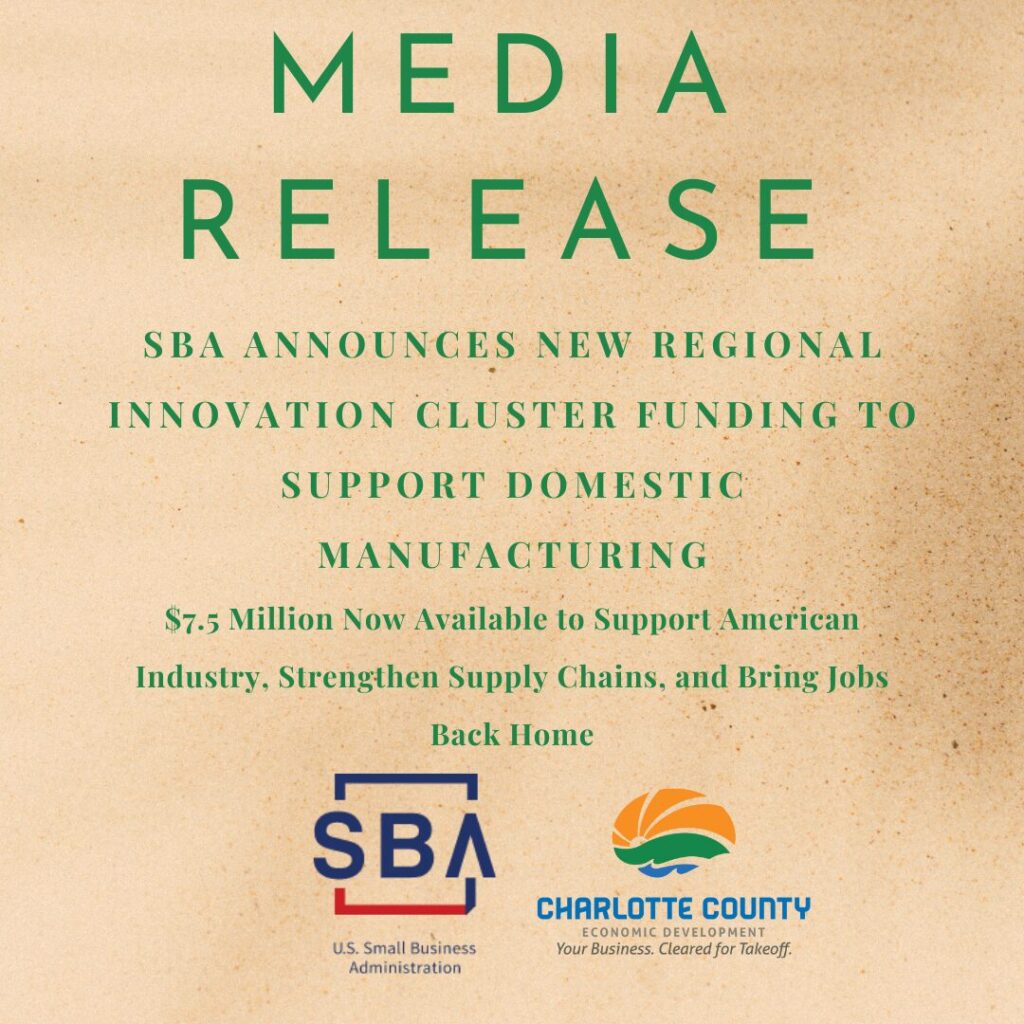
SBA Announces New Regional Innovation Cluster Funding to Support Domestic Manufacturing
August 29th, 2025
Introduction
The U.S. Small Business Administration (SBA) has launched a powerful new opportunity for small manufacturers across the country. With up to $7.5 million in new Regional Innovation Cluster funding, the SBA is reinforcing America’s industrial base, securing supply chains, and helping small businesses reshore critical industries.
This program is about more than just dollars. It’s about restoring resilience, keeping jobs local, and positioning America as the leader in advanced industries once again. For the nation’s 98% of manufacturers who are small businesses, this is a lifeline. It represents support for the men and women who fuel innovation, create jobs, and strengthen local economies in every corner of the country.
Credit: SBA News Release
Regional Innovation Cluster Funding: What It Means
A Regional Innovation Cluster (RIC) is more than a network. It’s a powerful ecosystem where businesses, suppliers, universities, and institutions come together to solve problems, share resources, and drive growth.
The SBA’s funding aims to support up to 20 new clusters nationwide. Each cluster will provide technical assistance, mentorship, and access to funding pipelines. Small manufacturers that often struggle to navigate red tape will gain a built-in support system designed to help them scale.
When small manufacturers are clustered together, the benefits multiply:
-
Knowledge and best practices spread faster.
-
Companies find suppliers and partners more easily.
-
Innovation happens quicker because the right people and ideas are connected.
Think of it like a magnet. When businesses gather in one place, they pull in investment, talent, and resources. That’s exactly what RIC funding is meant to do.
Why Small Manufacturers Benefit Most
Small manufacturers are the foundation of America’s industrial strength, but they face unique challenges. They often lack access to the same resources, global networks, or capital that larger corporations enjoy.
This is where RIC funding becomes critical. It bridges the gap by providing:
-
Technical support: Assistance in navigating compliance, safety standards, and procurement requirements.
-
Partnerships: Networking with universities, local governments, and larger manufacturers.
-
Technology adoption: Support in implementing automation, artificial intelligence, and other advanced tools.
-
Market access: Easier entry into both government and private supply chains.
For a small machine shop in the Midwest or a tech-focused startup in Florida, this support can be the difference between staying small or scaling into a major player.
SBA’s Focus on Critical Industries
The SBA has identified priority industries that are crucial for national security and economic leadership. Each of these fields faces global competition and supply chain vulnerabilities. By directing funding here, the SBA ensures America can compete and win.
-
Advanced Manufacturing: Driving efficiency, precision, and new methods like additive manufacturing.
-
Critical Minerals: Ensuring independence from foreign suppliers for materials essential to defense and clean energy.
-
Nuclear Microreactors: Supporting safe, reliable, and scalable clean energy solutions.
-
Quantum Technology & Artificial Intelligence: Building the backbone of next-generation computing and systems.
-
Information Technology & Cybersecurity: Protecting U.S. infrastructure, businesses, and citizens from digital threats.
-
Semiconductors: Restoring American dominance in chip production, the “brain” of modern technology.
These industries aren’t just high-tech buzzwords. They create real jobs—from engineers and machinists to cybersecurity analysts and logistics managers. For communities across America, this funding means new career pathways and stronger local economies.
A Push to Reshore Jobs and Industries
Reshoring is the heartbeat of this initiative. For too long, America relied heavily on overseas suppliers for critical goods. The pandemic exposed how fragile that model was. Empty shelves, delayed production, and disrupted supply chains revealed the dangers of dependence.
By supporting regional clusters, the SBA is helping small businesses bring jobs and production back to U.S. soil. Reshoring not only strengthens the economy—it strengthens national security. When America makes its own chips, minerals, and energy systems, it’s less vulnerable to global shocks.
This also fuels community revitalization. When manufacturing jobs return, so do opportunities. Families thrive, local tax bases grow, and entire regions benefit.
A History of Regional Innovation Clusters
The SBA first launched the RIC initiative in 2010. Since then, clusters have proven their value in industries ranging from bio-health to energy.
Clusters work because they concentrate talent and resources. A lone business may struggle to get the attention of investors or government buyers. But a cluster—a united group of businesses, suppliers, and researchers—carries weight. It gets noticed.
Past successes include clusters that helped small businesses secure defense contracts, develop new technologies, and expand into global markets. The new $7.5 million investment builds on this momentum, scaling what has already worked.
How Businesses Can Get Involved
The SBA is currently accepting competitive proposals from organizations looking to create new clusters.
Key details include:
-
Deadline: August 8, 2025, at 4 p.m. ET
-
Who should apply: Organizations with strong partnerships and proven track records in supporting small businesses
-
Focus: Proposals should target industries aligned with SBA’s priorities (manufacturing, IT, semiconductors, etc.)
Businesses that want to benefit should connect with organizations in their region that are preparing proposals. Even if a company isn’t leading a cluster, joining one provides access to shared resources and funding.
Learn more at: sba.gov/funding-programs/innovation
The Broader Impact on America’s Economy
The ripple effect of this funding will be profound. Consider the impact:
-
Job creation: High-quality manufacturing jobs will return to communities.
-
Supply chain resilience: America will rely less on foreign suppliers.
-
Innovation hubs: Clusters will attract talent, startups, and investment.
-
Global competitiveness: U.S. companies will lead in industries that define the future.
Economists often compare clusters to “greenhouses for business.” They provide the right conditions for small businesses to grow faster and stronger.
When combined with private investment, the SBA’s $7.5 million could unlock hundreds of millions in economic activity across the nation.
Looking Ahead: Building Industrial Strength
This announcement signals more than just funding. It’s a long-term strategy to ensure America remains competitive in a world where technology and manufacturing drive global power.
For small businesses, this is a rare chance to be at the forefront of growth. For communities, it’s an opportunity to anchor local economies in industries that will last decades.
The SBA’s vision is clear: a future where American small businesses lead the world in advanced manufacturing and innovation. With Regional Innovation Cluster funding, that future feels closer than ever.
FAQs
What is Regional Innovation Cluster funding?
It’s an SBA initiative that supports networks of small businesses and partners in key industries to accelerate growth.
How much funding is available?
Up to $7.5 million total, supporting as many as 20 new clusters.
Who can apply for RIC funding?
Organizations with proven success in helping small businesses, such as universities, nonprofits, and business development groups.
When is the application deadline?
August 8, 2025, at 4 p.m. ET.
Why is this important for small manufacturers?
They make up 98% of U.S. manufacturing firms but often lack resources to scale. RIC funding bridges that gap.
What industries are prioritized?
Advanced manufacturing, critical minerals, nuclear microreactors, quantum technology, IT and cybersecurity, and semiconductors.
Conclusion
The SBA’s new Regional Innovation Cluster funding is more than a grant program—it’s a bold vision for the future of American manufacturing. By bringing together small businesses, universities, and partners into clusters, the initiative strengthens supply chains, restores jobs, and powers innovation.
This $7.5 million investment is only the beginning. For local economies, it promises jobs. For small businesses, it delivers opportunity. And for America, it ensures a stronger, more secure industrial base for decades to come.
Sources
SBA News Release
SBA Regional Innovation Clusters Program