Building Tomorrow’s Talent Today: Charlotte County’s Workforce Development Strategy.
October 23rd, 2025
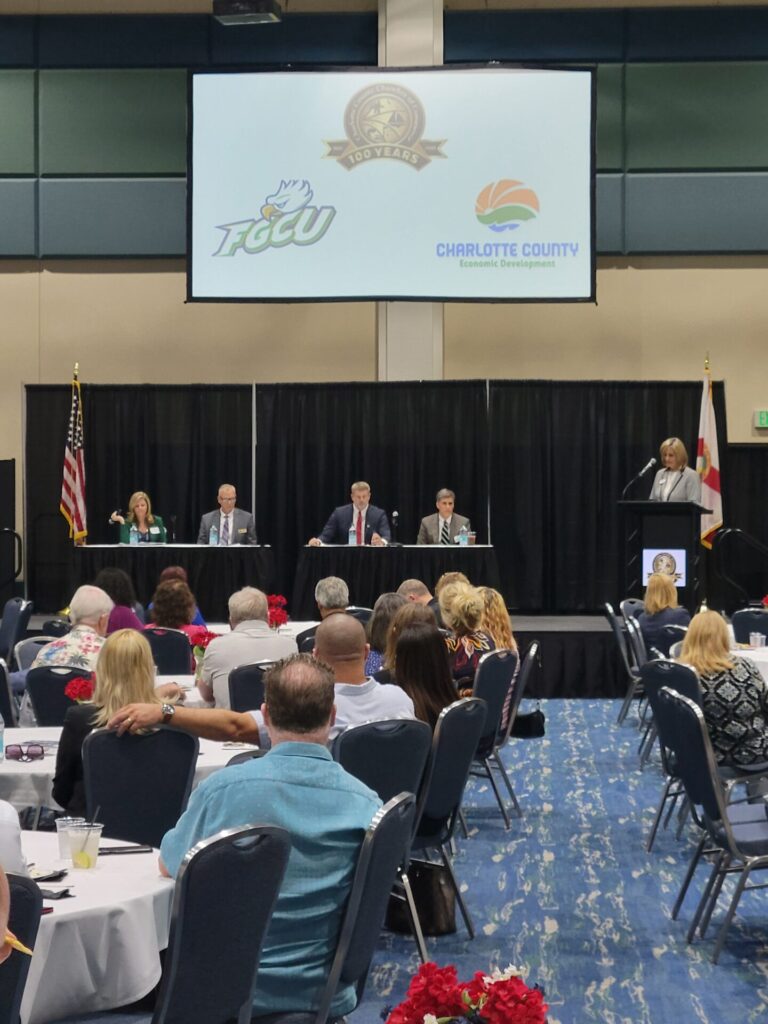
This article expands on key themes from the Charlotte County Workforce Roundtable, a community forum where local leaders discussed challenges and opportunities in building a stronger workforce. Listen to the event here: https://tinyurl.com/5n953x8v.
Introduction: Growth with Intention
Charlotte County’s growth is impressive and purposeful. In just two years, the population grew by more than 11 percent. That increase brought nearly 11,000 new homes and thousands of residents and businesses. Growth at this pace brings both opportunity and responsibility. It requires a plan to ensure that every part of the community—schools, employers, healthcare, and housing—advances together.
The Charlotte County Workforce Development Strategy was designed to meet that challenge. It is the product of collaboration among the Charlotte County Economic Development Office (EDO), Florida Gulf Coast University (FGCU), and the Charlotte County Chamber of Commerce. Together, they developed a framework centered on four pillars that guide long-term prosperity:
- Education Alignment and Early Career Exposure
- Healthcare Resilience and Workforce Stability
- Innovation and Economic Growth
- Quality of Life and Talent Retention
Each pillar connects to the others, creating a balanced and sustainable path for the future.
Pillar 1: Education Alignment & Early Career Exposure
Developing Relevant Talent Pipelines
Charlotte County Public Schools view workforce development as a shared community goal. Students begin exploring careers in middle school and continue through high school. By graduation, each student selects a “career E”—Employment, Enrollment, or Enlistment. These tracks ensure that graduates are ready for their next step the day after they receive their diploma.
Programs in aviation, advanced manufacturing, cybersecurity, and healthcare were built based on employer needs. As a result, coursework directly reflects the real skills local industries require.
Two major events connect education with employers: the Middle School Exploration Fair in January and the High School Career Fair in April. At these events, every student interacts with local companies and learns about opportunities close to home.

Academic excellence has risen alongside workforce readiness. Charlotte County recently reported its highest academic performance since 2013, proving that career relevance can boost classroom success.
Higher Education Collaboration
Higher education partners extend this local pipeline. FGCU and Florida SouthWestern State College (FSW) work closely with employers to align degrees, certificates, and internships with workforce demand.
Through FGCU’s Eagle Career Network, employers post openings, connect with students, and host on-campus recruiting events. Its Service Learning Program, which requires 80 hours of career-based community service, links classroom learning with practical experience.
Academic initiatives at Babcock Ranch, the Center for Supply Chain Excellence, and the Dendritic Institute for Human-Centered AI give Charlotte County employers access to applied research and technology-driven training. FGCU’s focus on sustainability, logistics, and data analytics strengthens the region’s economic diversity.
Together, these collaborations create a seamless “learn-here, work-here” culture that keeps local graduates in the community.
Pillar 2: Healthcare Resilience & Workforce Stability
Building a Stronger Healthcare Pipeline
Healthcare represents about 16 percent of Charlotte County’s total jobs. As population and retirement figures rise, so does the demand for skilled professionals. Hospitals, clinics, and long-term care facilities all need nurses, lab specialists, imaging technicians, and therapists.
HCA Florida Fawcett Hospital plays a central role in training the local healthcare workforce. By serving as a clinical site for universities and technical schools, it gives students direct experience in patient care. This approach builds familiarity, strengthens community ties, and increases the likelihood that graduates stay in Charlotte County.
The hospital also participates in early outreach programs that introduce healthcare careers to high school students. These initiatives help young people understand the variety of well-paid, high-skill jobs available in their own county.
Technology and Workforce Retention
HCA’s recent expansion improved both capacity and technology. The hospital’s $6 million investment added new surgical robotics and a tele-neurology system. The system allows specialists to evaluate stroke patients within minutes of arrival, reinforcing its status as Charlotte County’s only comprehensive stroke center.
Technology supports, rather than replaces, healthcare professionals. HCA Healthcare’s national partnerships with AWS and Microsoft promote ethical artificial intelligence that reduces paperwork and streamlines operations. This innovation lets caregivers spend more time with patients instead of screens.
Employee retention is also a top priority. Tuition assistance, career-ladder programs, and skill-based certifications help employees grow within the organization. This long-term investment builds loyalty and reduces turnover across the healthcare system.
Pillar 3: Innovation & Economic Growth
Managing Expansion Through Data
According to Metro Forecasting Models, Charlotte County is projected to add roughly 33,000 residents by 2030. During that time, the county will also support more than 1.1 million square feet of new industrial and commercial space.
These projections highlight the need for coordinated planning. County leaders continue to use data to guide infrastructure investments and workforce training programs. By aligning education and business recruitment with verified labor trends, Charlotte County can sustain growth without losing balance.
The strategy also focuses on competitive differentiation. By maintaining a clear regulatory structure and reasonable tax environment, the county attracts new employers while protecting affordability for residents.
Cultivating an Innovation Ecosystem
Charlotte County’s innovation strategy extends far beyond industrial recruitment. It includes nurturing the local creative economy. Coworking centers, libraries, and community gathering spots encourage entrepreneurs and professionals to connect and share ideas. These “third spaces” generate collaboration and innovation across industries.
FGCU’s Lucas Institute for Real Estate Development and Finance provides real-time market insights that help guide responsible development. The university’s partnership with Babcock Ranch also supports research in renewable energy, smart technology, and sustainable design.
Investments at Punta Gorda Airport (PGD) and along major transportation corridors are improving logistics access for advanced manufacturing and aerospace companies. These efforts position Charlotte County as a regional hub for both innovation and opportunity.
Pillar 4: Quality of Life & Talent Retention
Housing and Affordability
Affordable housing is essential for retaining workers. Local employers consistently identify housing costs as a major factor in hiring and retention. To address this, Charlotte County has expanded mixed-use zoning and supported new residential development that integrates with schools, parks, and public transportation.
New neighborhoods offer shorter commutes and greater affordability. These measures make it easier for first-time homebuyers and essential workers—such as teachers, nurses, and technicians—to live where they work.
Childcare and Family Support
Access to childcare is equally important. Employers who offer on-site or shared childcare programs report stronger retention and employee satisfaction. Local partners are exploring new models that combine public and private resources to meet community demand. These efforts help families balance career advancement with stability at home.
Lifestyle and Community Identity
Quality of life remains one of Charlotte County’s strongest advantages. The county’s beaches, parks, and harbor access attract professionals who value both work and recreation. Initiatives like My Best Side Is Outside highlight outdoor amenities that set the area apart from larger metros.
Cultural growth complements the natural environment. Expanding art programs, community festivals, and broadband access enhance livability for both residents and remote professionals. Together, these elements make Charlotte County a place where people can build meaningful, lasting careers.
A Culture of Collaboration
The county’s progress is driven by teamwork. The EDO, Chamber of Commerce, FGCU, public schools, and healthcare organizations all operate under a shared vision. Each partner contributes expertise while avoiding duplication. This unified approach keeps education, housing, and workforce programs aligned with real-time needs.
The Workforce Development Strategy has transformed collaboration into policy. Businesses influence curricula, educators adapt programs to labor demand, and government agencies ensure that quality of life grows alongside the economy. This partnership model creates a foundation for sustainable, long-term prosperity.
Conclusion: A Future Built on People
Charlotte County’s Workforce Development Strategy shows what can happen when growth is guided by purpose. By connecting education, healthcare, innovation, and quality of life, the county is creating an economy that works for everyone.
Each pillar supports the next: education builds talent, healthcare protects it, innovation advances it, and quality of life retains it. This framework ensures that Charlotte County remains resilient, competitive, and deeply connected to its people.
In Charlotte County, tomorrow’s talent is being built today—through collaboration, preparation, and shared commitment to the future.