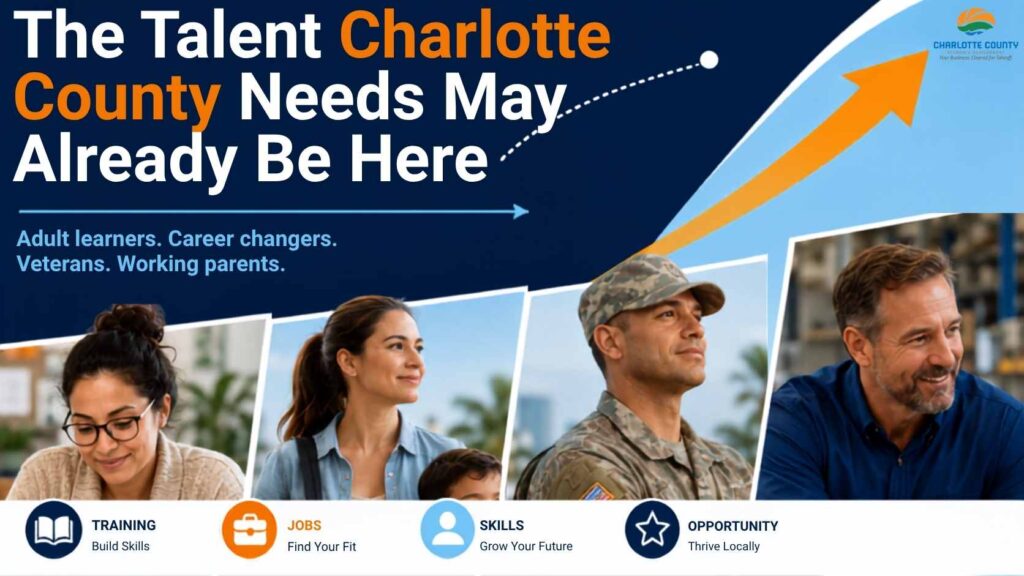
The Talent Charlotte County Needs May Already Be Here
June 29th, 2026
When businesses talk about workforce challenges, the conversation often starts with recruiting.
- How do we attract more workers?
- How do we bring more people here?
- How do we fill open positions faster?
Those are important questions. But they are not the only questions.
Charlotte County’s future workforce may not only come from outside the area. Some of the talent employers need may already be here.
They may be adult learners, career changers, veterans, parents returning to work, GED completers, underemployed residents, or people who have skills but need a clearer pathway. They may be ready for opportunity but unsure where to start.
A stronger workforce pipeline does not only mean attracting new talent. It also means helping local talent connect to local opportunity.
Talent does not always follow a traditional path
Not every worker follows the same route from classroom to career.
- Some people go directly from high school to college.
- Some enter a technical program.
- Some join the military.
- Some start working right away.
- Some pause their careers to raise children or care for family.
- Some return to school later.
- Some need a certification, credential, or short-term training program to move into a better job.
For employers, this means the next great employee may not have a perfect résumé or a traditional career timeline. They may have life experience, reliability, customer service skills, military training, caregiving experience, or a strong work ethic built outside a classroom.
Skills-based hiring can help employers see that potential. Instead of focusing only on degrees or job titles, businesses can look more closely at what a person can do, what they are ready to learn, and how they can grow within the organization.
Local talent needs clear onramps
People cannot take the next step if they do not know where the next step is.
- A parent returning to work may need training options.
- A veteran may need help translating military experience into a civilian career.
- A career changer may need to understand which local industries are growing.
- An underemployed worker may need a credential or a better pathway.
- A student or recent graduate may need experience, a job search tool, or a connection to employers.
That is why onramps matter. They turn a broad workforce message into something practical.
Looking for your next step in Charlotte County?
Whether you are changing careers, returning to work, building new skills, or looking for a better opportunity, Careers on the Coast can help you explore job search tools, training options, internships, apprenticeships, and local career pathways.
Not sure where to begin?
Start with career pathways, local resources, and next-step guidance.
Ready to look for work?
Use job search resources connected to Charlotte County and Southwest Florida.
Need new skills?
Find training, upskilling, technical education, and partner resources.
Want to earn while you learn?
Learn how apprenticeships connect paid work, hands-on training, and long-term careers.
Want to stay connected?
Join the Talent Network for workforce updates, career resources, and local opportunities.
Employers can reduce barriers
A strong talent pipeline requires more than job postings. It requires employers to understand the barriers that may keep good candidates from applying, accepting, or staying in a role.
Those barriers may include childcare, transportation, scheduling conflicts, limited awareness of local careers, gaps in training, unclear advancement opportunities, or hiring requirements that may not match the actual skills needed.
Not every barrier can be solved by one employer. But businesses can start by asking better questions.
Which requirements are truly necessary? Can we train for some skills on the job? Are there flexible scheduling options? Can we partner with training providers? Are we clearly showing how employees can grow? Are we overlooking people who could succeed with the right support?
Local talent supports local growth
Building a stronger local workforce benefits everyone.
Employers gain access to people who are already connected to the community. Residents gain clearer pathways to better jobs. Families gain more stability. Training partners gain better insight into employer needs. Charlotte County strengthens its ability to support business growth from within.
This is not only a workforce strategy. It is an economic mobility strategy.
When more residents can move into meaningful careers, the community becomes stronger. When employers invest in local talent, they help build the workforce they need for the future.
Careers are built here
Charlotte County’s workforce future depends on both attraction and development.
Yes, we need to attract talent. But we also need to recognize, support, and grow the talent already here.
The next great employee may be a parent returning to work. A veteran looking for a new career. A student in an adult education program. A worker ready to move up. A resident who needs one credential, one connection, or one employer willing to open the door.
The talent Charlotte County needs may already be here.
Now the work is helping people see the pathway.
Employers: Look closer at the talent already in Charlotte County.
Charlotte County Economic Development can help connect businesses with workforce, education, and community partners. Explore the Employer Action Guide to find practical ways your business can support adult learners, career changers, working parents, veterans, and local talent pathways.
Continue the workforce conversation
The Talent Pipeline Starts Here
Learn why workforce development starts long before the job application.
Childcare Is Workforce Infrastructure
See why supporting working families is part of strengthening the workforce.
Students Cannot Pursue Careers They Never See
Explore why work-based learning helps students connect classrooms to careers.