Childcare Is Workforce Infrastructure: Why It Belongs in Charlotte County’s Workforce Conversation
June 26th, 2026
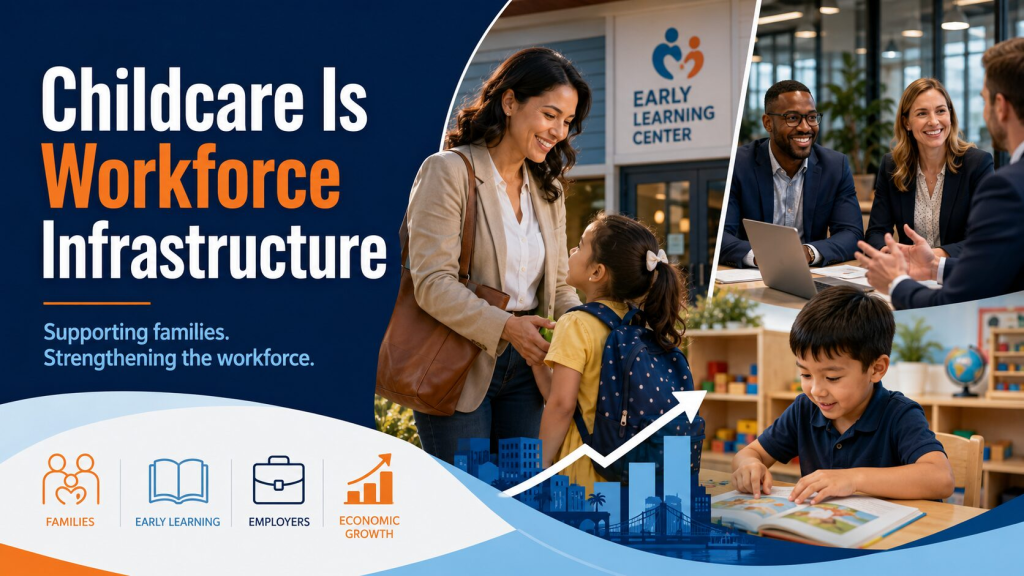
Childcare Is Workforce Infrastructure: Why It Belongs in Charlotte County’s Workforce Conversation
Childcare is not only a family issue. It is a workforce issue. The challenges facing the childcare workforce in Charlotte County also affect the wider community.
It affects whether parents can work, whether employers can retain talent, whether families can accept promotions, whether students are ready to learn, and whether communities can build the workforce they need for the future.
That message was clear throughout the Florida Learners to Earners Workforce Solution Summit, where early learning, childcare, education, training, and workforce development were all part of the same conversation. The Florida Chamber Foundation’s 2026 Learners to Earners Workforce Solution Summit was focused on investing in Florida’s current and future workforce to build a stronger talent pipeline.
For Charlotte County, this matters because workforce development cannot begin at the job posting.
It starts much earlier.
It starts when children have access to safe, reliable, quality early learning. It starts when working parents can remain in the workforce. It starts when employers recognize that childcare challenges can become hiring, retention, productivity, and growth challenges.
If we want to strengthen Charlotte County’s talent pipeline, childcare has to be part of the strategy.
Childcare Affects Today’s Workforce
When working parents cannot find or afford reliable childcare, the impact does not stay at home.
It shows up at work.
Parents may miss shifts. They may reduce hours. They may turn down promotions. They may leave jobs completely. Employers may face higher turnover, more absenteeism, scheduling challenges, productivity losses, and a smaller pool of available workers.
The Florida Chamber Foundation has identified lack of affordable and accessible childcare as the number one reason parents with children under 6 leave their jobs in Florida.
That is not just a childcare problem. That is a business problem.
In a competitive labor market, employers are already working hard to recruit and retain talent. When childcare becomes unstable, the workforce becomes unstable too. This can be especially challenging for industries with early mornings, late shifts, weekend hours, healthcare schedules, hospitality needs, manufacturing shifts, construction start times, and other jobs that do not always fit neatly within traditional childcare hours.
For working families, the issue can become a daily calculation.
Can I afford to work?
Can I take this shift?
Can I accept more hours?
Can I go back to school?
Can I take the promotion?
Can I stay in this job?
When the answer is no, businesses feel it.
Childcare Affects Future Talent Too
The workforce conversation is often focused on immediate needs.
Who can we hire now?
What positions are open?
What skills are missing?
How do we fill hard-to-staff roles?
Those questions matter, but they are only part of the picture.
A strong workforce also depends on long-term talent development. That means early learning matters. Kindergarten readiness matters. Reading matters. Math matters. Confidence, communication, persistence, and problem solving all begin developing long before a student enters high school or applies for a job.
The Florida Chamber Foundation’s Business Alliance for Early Learning was created to raise awareness among business leaders about the importance of early learning for children ages 0 to 8.
That is why early learning belongs in the same conversation as career pathways, technical training, apprenticeships, and employer engagement.
If students are tomorrow’s workforce, then early learning is part of workforce development.
This does not mean every business has to become a childcare expert. It means businesses should understand how early learning and childcare access affect the talent pipeline from both sides: today’s working parents and tomorrow’s future workers.
The Economic Impact Is Real
Childcare challenges have measurable economic consequences.
The Florida Chamber Foundation’s Untapped Potential in FL research, conducted in partnership with the U.S. Chamber of Commerce Foundation, found that insufficient childcare availability costs Florida an estimated $5.38 billion each year. The same research estimated that childcare-related employee turnover and absenteeism costs Florida employers $3.47 billion per year.
Those numbers make the issue hard to ignore.
For employers, childcare access can influence whether people show up, stay employed, advance, or leave. For communities, it can influence labor force participation, household stability, school readiness, and future economic mobility.
For Charlotte County, it also connects directly to workforce attraction.
When families are deciding where to live, work, and build a future, they look at more than job openings. They look at quality of life. They look at schools. They look at childcare. They look at whether the community supports working families.
A strong childcare and early learning environment helps tell a stronger workforce attraction story.
Employers Can Play a Role
Employers do not have to solve childcare alone.
In fact, they should not be expected to.
But employers can be part of the solution.
The first step is understanding how childcare affects their own workforce. Employers can look at absenteeism trends, turnover patterns, scheduling challenges, exit interviews, and employee feedback. They can ask whether childcare is creating barriers for current or potential employees.
From there, businesses can consider practical steps.
Some may choose to share childcare resources with employees. Some may explore flexible scheduling where possible. Some may participate in local conversations with childcare providers, schools, and workforce partners. Some may consider benefits, stipends, or partnerships. Some may look into available tax credit opportunities. Others may simply start by acknowledging that childcare is a real workforce factor.
Florida’s child care tax credit provides a potential tool for businesses that want to support employee childcare needs while receiving possible tax savings.
The right option will look different for every employer.
A small business may not have the same resources as a large company. A manufacturer may have different needs than a healthcare provider. A hospitality employer may face different scheduling challenges than a professional office.
But every employer can start with awareness.
Why This Matters for Charlotte County
Charlotte County’s workforce future depends on connection.
We need students connected to career pathways. We need employers connected to training partners. We need workers connected to opportunity. We need families connected to the support systems that help them stay in the workforce.
Childcare is part of that connection.
As Charlotte County continues to grow its Careers on the Coast workforce attraction efforts, childcare and early learning should remain part of the conversation. If we want people to build careers here, we also need to recognize what helps families build lives here.
That includes access to reliable care.
That includes early learning opportunities.
That includes employer awareness.
That includes community partnerships.
And it includes a broader understanding that workforce development is not one single program. It is a system.
From Conversation to Action
The Learners to Earners summit reinforced a key point: workforce development is a long game.
It includes early learning, K-12 education, career and technical education, adult learning, employer partnerships, work-based learning, and future skills. Childcare sits at the center of that system because it affects both immediate workforce participation and long-term student success.
For Charlotte County employers, the next step is not necessarily a large program.
It may be a conversation.
Ask employees what barriers they face.
Ask workforce partners what resources exist.
Ask childcare partners what gaps they see.
Ask how your business can support working families in practical ways.
Because when parents can work, businesses benefit.
When children are ready to learn, communities benefit.
When employers understand childcare as part of workforce infrastructure, Charlotte County’s talent pipeline becomes stronger.
Childcare is not separate from economic development.
It is part of it.
Want to be part of Charlotte County’s workforce conversation?
Charlotte County Economic Development works with businesses, education partners, childcare advocates, and workforce organizations to support a stronger local talent pipeline. Connect with our team to learn how your business can get involved.
Employers: Ready to help build Charlotte County’s talent pipeline?
Businesses play a direct role in helping students, adult learners, working parents, and career changers connect to local opportunity. Explore the Careers on the Coast Employer Toolkit for practical resources to support hiring, training, retention, internships, apprenticeships, and workforce partnerships.