The Talent Pipeline Starts Here: What Florida’s Workforce Conversation Means for Charlotte County
June 26th, 2026
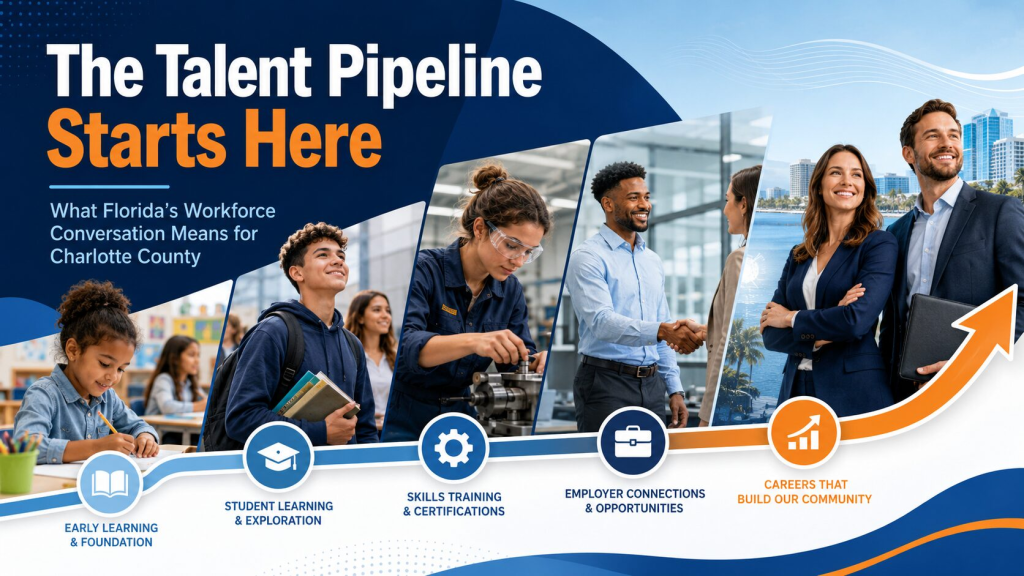
Workforce development does not start when someone applies for a job. In Charlotte County, workforce development efforts are focused on building skills and opportunities long before the job search begins.
It starts much earlier.
It starts when young children are ready to learn. It grows when students understand local career options. It becomes stronger when employers open their doors, share what skills they need, and help people see a future in their own community.
That was one of the clearest takeaways from the Florida Learners to Earners Workforce Solution Summit, a statewide conversation focused on the full talent pipeline, from early learning to adult education, career pathways, employer partnerships, and the future of work.
For Charlotte County, the message matters.
A strong workforce is not built by one organization. It takes schools, employers, workforce partners, families, training providers, community leaders, and economic development working together. If we want businesses to grow here, and if we want residents to build meaningful careers here, we have to think about talent as part of our long-term economic strategy.
Talent Is Economic Development
For years, economic development conversations focused heavily on sites, buildings, infrastructure, and business attraction.
Those things still matter. But today, talent is one of the biggest factors driving business decisions.
Companies want to know if they can find workers. They want to know if there are training programs nearby. They want to know if local students understand career opportunities. They want to know if working parents can stay in the workforce. They want to know if the community is preparing people for the jobs that exist now and the jobs that are coming next.
That makes workforce development a core part of economic development in Charlotte County.
When we talk about business recruitment, expansion, retention, and workforce attraction, we are also talking about people. We are talking about students, parents, teachers, adult learners, career changers, veterans, underemployed workers, and employers trying to fill critical roles.
A strong talent pipeline helps all of them.
Workforce Starts Earlier Than Most People Think
One of the strongest themes from the summit was that workforce development begins long before high school graduation.
Early learning matters. Kindergarten readiness matters. Reading, math, communication, and problem-solving skills matter. When children build a strong foundation early, they are more likely to succeed in school and move into career pathways later.
This is why childcare and early learning belong in the workforce conversation.
For working parents, access to reliable childcare can affect whether they are able to work, accept a promotion, complete training, or stay in a job. For employers, childcare challenges can show up as absenteeism, turnover, reduced hours, and hiring difficulty.
For a community, it affects both today’s workforce and tomorrow’s.
That is why Charlotte County’s workforce strategy cannot begin at the job posting. It has to include conversations about families, education, childcare, and access to opportunity.
Students Need to See Local Careers
Students cannot pursue careers they never see.
That sounds simple, but it is one of the most important workforce lessons for any community. Many students know about doctors, teachers, police officers, and professional athletes. Fewer students understand the full range of careers available in advanced manufacturing, aviation, logistics, construction, healthcare technology, marine trades, public service, entrepreneurship, and skilled trades.
That is where employers can make a real difference.
A business does not have to launch a major internship program on day one. It can start by hosting a student tour, speaking to a class, participating in a mock interview day, offering job shadowing, or helping educators understand what skills are needed in the workplace.
Those small steps matter.
They help students connect classroom learning to real careers. They help teachers and counselors understand local opportunities. They help employers build awareness before they have an urgent hiring need.
Most importantly, they help students imagine a future here.
Not Every Career Path Looks the Same
A strong workforce needs more than one pathway.
Some students will attend a university. Some will attend a state college. Some will enter career and technical education programs. Some will earn industry certifications. Some will join apprenticeships. Some will go straight into the workforce and continue learning on the job. Some adults will return to training after years away from school.
All of those pathways matter.
Charlotte County’s workforce future depends on making career options visible, practical, and connected to real employer needs. That means supporting career and technical education, short-term training, work-based learning, adult education, and employer partnerships that help people move from learning to earning.
It also means recognizing that talent may already be here.
Adult learners, career changers, parents returning to work, veterans, GED completers, and underemployed residents may be part of the solution for local businesses. With the right training, support, and employer engagement, more people can connect to meaningful work.
Employers Are Part of the Solution
The businesses that succeed in a competitive labor market are not just waiting for talent to appear.
They are helping build it.
Employers can share hiring needs with education and workforce partners. They can help shape training programs. They can create career ladders for current employees. They can make entry-level jobs easier to understand. They can expose students to careers earlier. They can support working parents. They can consider new talent pools.
This does not mean every employer has to do everything.
It means every employer can do something.
A classroom visit, a facility tour, a conversation with a training provider, or a few hours spent helping students understand a career path can make a difference.
Charlotte County’s Opportunity
Charlotte County has a strong story to tell.
We have growing industries, quality of life, career opportunities, education partners, workforce organizations, and employers who care about the future of this community. Through initiatives like Careers on the Coast, 40 Under 40, business retention and expansion efforts, workforce conversations, and local partnerships, we can continue showing that Charlotte County is a place where people can build both a career and a life.
The next step is turning conversation into action.
That means continuing to connect businesses with schools. It means helping employers understand workforce resources. It means telling stories about local career pathways. It means supporting childcare and early learning as part of the workforce system. It means making sure students and workers can see a future here.
Because workforce development is not one program.
It is a community commitment.
And in Charlotte County, careers are built here.
Want to be part of Charlotte County’s workforce future?
Charlotte County Economic Development works with businesses, education partners, and workforce organizations to support a stronger local talent pipeline. Connect with our team to learn how your business can get involved.
Employers: Ready to help build Charlotte County’s talent pipeline?
Businesses play a direct role in helping students, adult learners, working parents, and career changers connect to local opportunity. Explore the Careers on the Coast Employer Toolkit for practical resources to support hiring, training, retention, internships, apprenticeships, and workforce partnerships.